Born in Milwaukee,
1969
Lives in Eugene, Oregon
[collection], 2001
www.maryflanagan.com/collection.htm
Networked software, computer, projector, projection surface
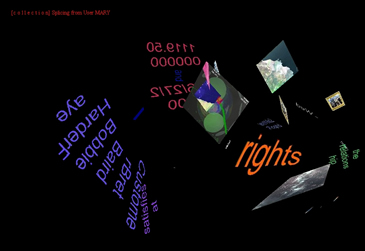
[collection] is a networked computer application that creates a visible, virtual collective unconscious. Bits and pieces of data--sentences from email or letters, graphics, images cached by a web browser, sound files, etc.--are harvested from the hard drives of users who have downloaded the [collection] software. A dynamic three-dimensional collage of images is created from this information, an ever-changing vision of users’ data. In combining and re-presenting information (both personal and computer-specific) from myriad users, [collection] uses the Internet as a collective memory space and in the process raises questions about the nature of memory as a network.
[collection] is an extension of Mary Flanagan’s previous project [phage], which created the same kind of moving 3D maps based on data culled from a single user's computer. The title [phage] refers to bacteriophage--from the Greek phagein, "to eat"--a virus that consumes harmful bacteria. Instead of being destructive, this virtual life-form treats data as raw material and brings up items from the depths of a computer’s memory. While [phage] allows a user to experience his or her own computer’s memory, [collection] extends this notion into the network, where the combined data becomes a multi-layered rendering of users’ life experiences. By allowing Flanagan’s software to recontextualize their personal data, users give up creative control over their machines and let their information be reshaped in a kind of non-hierarchical organization.
The data relationships Flanagan’s software explores connect to the promise of hypermedia. Electronic writing and imaging systems are intended to mimic the brain's ability to make associative references and its complex electrodynamics of consciousness. Like the human mind, [collection] seems to operate by association, snapping from one item to the next. By exploring the parallels and borders between human and computer memory in the form of a collective unconscious, [collection] reflects the profound impact of new media technology on our culture.
|